
Spring Isn’t Just for Growth. It’s for Replanting Your Funding Roots
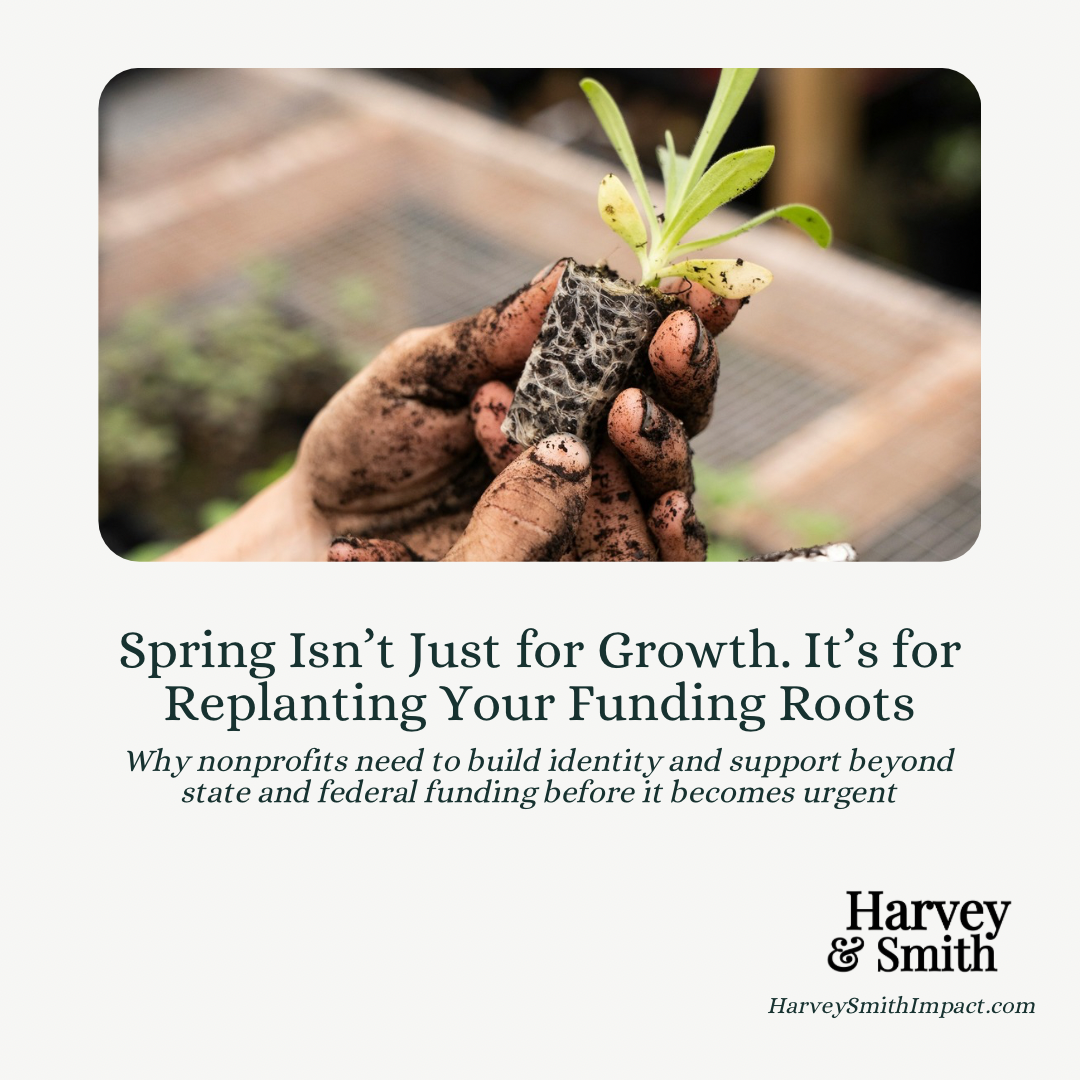
Spring tends to push nonprofits into growth mode. New programs, new partnerships, new funding targets. Everything starts to feel like it should be expanding. But growth is not always the right place to focus, especially for organizations that rely heavily on state or federal funding. Sometimes the more important question is not how to grow, but what you are actually rooted in.
Public funding can be a stabilizing force. It allows organizations to hire staff, expand services, and operate with a level of consistency that is hard to achieve otherwise. It can also quietly reshape how an organization understands itself. Over time, programs begin to align with funding requirements. Language shifts to match reporting expectations. Success becomes something that is defined externally, often through metrics that do not fully capture the work on the ground.
None of that is inherently a problem. But it does create a kind of dependency that is not just financial. It is structural and cultural. When a large portion of your budget comes from one system, your organization can start to mirror that system in ways that are not always obvious in the moment.
The real risk shows up when that funding changes or disappears. At that point, the challenge is not only replacing revenue. It is figuring out whether the organization still has a clear identity outside of those funding streams. That is a much harder problem to solve under pressure.
Spring is a good time to step back and look at that before it becomes urgent. Not from a place of panic, but from a place of clarity. What parts of your work exist because of funding, and what parts exist regardless of it? Where are your strongest relationships, and are they tied to programs or to trust? If your largest grant ended tomorrow, what would still feel solid and recognizable?
This is where the idea of replanting becomes useful. Not abandoning public funding, but building alongside it. Creating other roots that are not dependent on policy cycles or administrative priorities. That might mean developing a base of individual donors who understand your work beyond the numbers. It might mean investing in storytelling that reflects the reality of your work rather than the version that fits neatly into a report. It might mean creating space for community engagement that is not tied to deliverables.
It also requires being honest about what makes your organization distinct. Not in a branding sense, but in a practical one. What do people come to you for that they cannot get somewhere else? What do you hold that would be difficult to replicate? What would actually be lost if your organization were no longer there?
These are not questions most organizations take the time to answer when funding feels stable. But they are the ones that matter most when it is not.
The organizations that navigate funding shifts well are usually not the ones that react the fastest. They are the ones that already have a sense of who they are outside of any single funding source. They have relationships that are not transactional. They have language that feels like their own. They have supporters who are connected to the work itself, not just the outcomes attached to a grant.
Spring makes it easy to focus on what is growing. It is also a good moment to look at what is holding everything in place. Because growth without that foundation is rarely sustainable, and when things shift, it is the roots that determine what stays standing.