
The Work Behind the Work: What can your community count on?
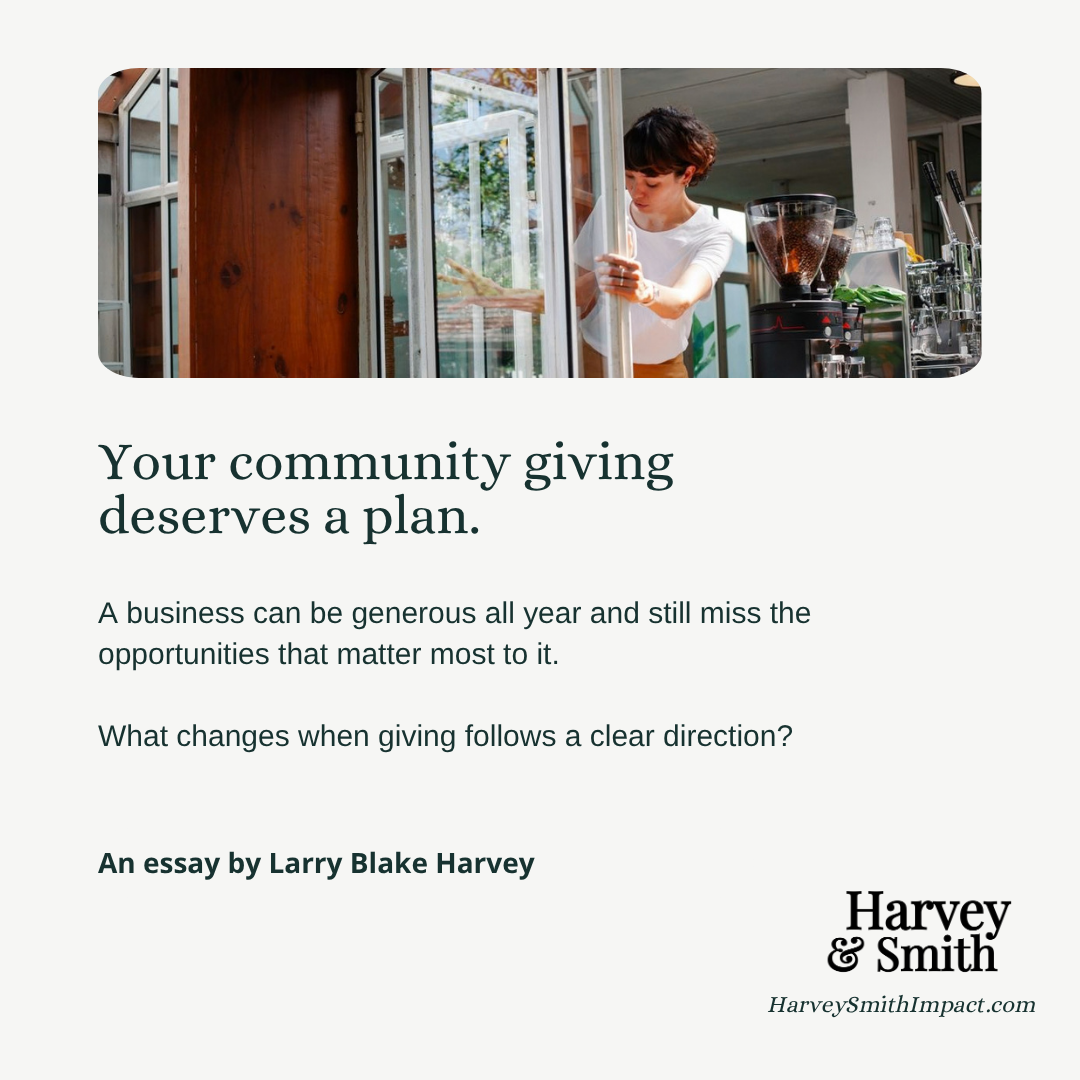
I’m interested in what happens after a business says yes.
Yes to the sponsorship. Yes to the donation drive. Yes to the local organization trying to keep something important going. Each decision can be generous and worthwhile. But taken together, do they reflect what the business actually wants to contribute?
Having worked with business owners and led a nonprofit, I’ve come to think that this is where a lot of opportunity sits. A business can already be doing good things and still benefit from stepping back, choosing a direction, and making commitments that others can plan around.
Imagine a local restaurant whose owner has been saying yes all year.
In the spring, a youth team needs help paying for uniforms. A few weeks later, a regular customer asks for gift cards for a school raffle. There are more raffles, a cold-weather clothing drive, and a table at a nonprofit’s annual fundraiser. The owner knows some of the people asking. Others explain a need that is easy to care about.
Each request gets considered on its own. There is money available, or a way to make it work, and the owner wants to help.
Then an organization approaches the restaurant about providing meals for a community program. Food access is something the owner cares about. The restaurant has skills and resources that could be genuinely useful. There is the possibility of a relationship here, something the business could become involved in over time.
But the giving budget is already spent.
The order of the requests has become the plan.
I think many business owners could recognize some version of this situation. Generosity is already present. So is a connection to the community. The opportunity is to give those things a clearer direction.
For our restaurant owner, that could begin by looking back over the year. Some contributions reflect relationships worth keeping. Others were easy to approve in the moment but have little connection to what the owner most wants the business to support. Seeing them together makes the pattern easier to understand.
The commitments already made still matter. The owner can honor them while deciding how to approach the next round of requests.
Suppose the restaurant chooses food access as its main focus for the coming year. It sets a budget it can sustain, including the cost of food and the staff time involved, and keeps a portion available for unexpected community needs. There is still room to respond when something important comes up. There is also room reserved for the work the owner has deliberately chosen.
That decision makes the next conversation possible.
Before promising meals, the owner sits down with the organization to understand what would help. Perhaps a monthly lunch would fill a real gap. But it needs to arrive at a particular time, in packaging the program can use, with dietary requirements accounted for. Someone has to deliver it. Someone has to know whom to call if plans change.
These details will determine whether the offer works.
From the nonprofit side, this is where a generous idea becomes something an organization can use. An offer can also bring extra work: finding storage for donated goods, sorting unsuitable items, or supervising volunteers when staff are already stretched. Asking what is needed gives the organization room to explain those realities before either side has committed.
In our example, the restaurant and the organization settle on one lunch delivery a month for an agreed period. The owner checks that the kitchen can manage it alongside its regular work. Employees who want to be involved have a way to participate, without that participation becoming an unspoken expectation of the job.
They agree on the purpose and scope of the contribution, the delivery dates, and a contact on each side. They also agree on when to review how it is working.
Now the organization has a commitment it can put on its calendar.
That is meaningful. The program’s staff can plan around the lunch. The restaurant can account for it in purchasing and staffing. The owner has made a decision that carries through to the people responsible for doing the work.
If a slower season makes the commitment harder to sustain, the relationship needs an early conversation. The organization deserves time to adjust. Together, they can discuss whether the arrangement needs to change at the next review, while being clear about what has already been promised.
This is part of what makes a business dependable. It understands the weight of its yes.
Eventually, there may be something worth sharing publicly. I think business owners can be honest about the value community involvement brings to their business. A thoughtful partnership can help customers understand what the company cares about and give employees a meaningful way to take part. Relationships and reputation matter.
The communication should be as considered as the contribution. The restaurant can credit the organization’s expertise, explain its own role accurately, and agree with the partner on appropriate recognition. Anyone receiving support should have a genuine choice about appearing in a photograph or story. A useful partnership should never depend on making someone’s circumstances public.
By the end of the partnership’s first year, the restaurant may have answered fewer requests. It has also given one organization a clearer understanding of what it can expect. The owner can explain why this work matters to the business, what it requires, and how it is being sustained.
A business cannot take responsibility for every need around it. It can take care with the commitments it chooses to make. For an owner already doing good things, looking at those commitments together may reveal a relationship worth deepening, a contribution worth changing, or space worth protecting for something important.
Before the next request arrives, there is a question worth asking: what can your community count on?